Functions
Code generation overview
- Recall: compiler takes source language and produces target language
- Translate, not execute
- Generates equivalent program in assembly
- Each language construct has corresponding assembly code patterns
What are functions in programming languages?
Function abstraction: encapsulate a computation
- Defined by name (usually) and its input/output
- User-defined extension of the language
- Lots of uses: abstraction, reuse, organization, interfaces, and more
- Higher-order functions can take functions as inputs
- Lambda functions allow runtime creation of anonymous functions
Function behavior
(Diagram)
- Caller transfers control to callee function
- Caller provides input values
- Callee provides output value(s)
- Execution resumes in caller once callee is finished
- One box for main
- One box for f
- Start running main (exec calls this)
- Stop running main and start running f
- Finish f, then resume main where we left off
- Parameters and return values
Function calls in assembly
A call to function f():
retval = f()A simple definition of a function f():
begin f()
return 5
end
x86-64 assembly
The assembly call is a branch to label f.
The function definition:
f:
  mov $5, %rax
  ret
This is the call to function f():
call f
mov %rax, -16(%rbp)
The return value is saved to register %rax by
convention, which is saved to a variable via a mov.
-16(%rbp) represents the retval variable.
We’ll see how this works below.
How call and
ret work
call f- First saves the return address
- Then branches to
f
ret- Retrieves the return address
- Then branches back to the return address
Example
   f:
1:    mov $5, %rax
2:    ret
   _start:
3:    call f
4:    mov %rax, -16(%rbp)
_start is the entry point to the program (think
main).
Diagram
- Instruction pointer (address of the next instruction to execute)
- Start at instruction pointer 3 (
_startlabel) - Execute call
- Save return address (instruction pointer + 1 = 4)
- Branch to f (instruction pointer = 1)
- Execute mov
- Execute ret
- Retrieve return address (instruciton pointer = 4)
- Execute mov
What if we have multiple nested function calls?
Use a stack
We need to save multiple return addresses while we wait for returns
Multiple calls
   h:
1:    mov $7, %rax
2:    ret
   g:
3:    call h
4:    ret
   _start:
5:    call g
6:    mov %rax, -16(%rbp)
Diagram
- Start at instruction pointer 5 (
_startlabel) - Execute call
- Push return address on to stack (instruction pointer + 1 = 6)
- Branch to g (instruction pointer = 3)
- Execute call
- Push return address on to stack (instruction pointer + 1 = 4)
- Branch to h (instruction pointer = 1)
- Execute mov
- Execute ret
- Retrieve return address (instruciton pointer = 4)
- Execute ret
- Retrieve return address (instruciton pointer = 6)
- Execute mov
Function-local variables
int saved_n;  // One variable for all calls to f()

int f(int n) {
  int f_n;

  if (n <= 1) {
    return 1;
  } else {
    saved_n = n;
    n = n - 1;
    f_n = f(n);
    return f_n * saved_n;
  }
}

int main() {
  f(3);
}
Diagram
- f(3)
- saved_n = 3
- f(2)
- saved_n = 2
- f(1)
- return 1;
- f_n = 1
- f_n * saved_n = 1 * 2
- return 2
- f_n = 2
- f_n * saved_n = 2 * 2 (want this to be 2 * 3, but saved_n was overwritten)
We need saved_n to be function-local
We need a fresh memory location for each call to a function,
i.e., each call to f.
If instead we have one memory location for each definition, recursion will not work as expected.
Factorial with function-local variables
int f(int n) {
  int saved_n;  // One variable for each call to f()
  int f_n;

  if (n <= 1) {
    return 1;
  } else {
    saved_n = n;
    n = n - 1;
    f_n = f(n);
    return f_n * saved_n;
  }
}

int main() {
  f(3);
}
How do we store function-local variables? Use a stack
Diagram
- f(3) (push locals to the stack)
- saved_n = 3
- f(2) (push locals to the stack)
- saved_n = 2
- f(1) (push locals to the stack)
- return 1;
- f_n = 1
- f_n * saved_n = 1 * 2
- return 2
- f_n = 2
- f_n * saved_n = 2 * (now this is 2 * 3, because saved_n for f(2) was saved)
Local variable allocation
begin example_variables()
locals x, y
x = 1
y = x
return y
end
x86-64 stack operations
- Register
%rspalways points to top element of the stack pushpushes value to stackpoppops value from stack
The stack grows downwards
- Bottom of stack is a higher memory address
- Top of stack is a lower address
- Push
- Subtracts from stack pointer
- Copy data into stack pointer address
- Pop
- Copy data from stack pointer address
- Add to stack pointer
Implementation of push and pop -
push %rax is equivalent to - sub $8, %rsp -
mov %rax, (%rsp) - pop %rax -
mov (%rsp), %rax - add $8, %rsp
Technically there are multiple push operations depending on the type and size of the operand
Allocating space for local variables
Slang
begin example_variables()
locals x, y
# ...
return y
end
Assembly:
example_variables:
  sub $16, %rsp # Allocate stack space for locals
  # ...
  add $16, %rsp # Deallocate stack spcae for locals
  ret
Diagram
- Show stack space in memory, label stack entries with addresses
- Start with the stack and stack pointer (show its value, not just as an arrow)
- Step through each instruction
- Show how the stack pointer and memory is updated
Using stack space for local variables
- Assign each variable to a stack entry
- Effectively an array of local variables
Diagram
- Draw stack for
example_variables - Name each stack entry according to the variable name
Allocating local variables
- Save the address of the local variables
- The base pointer
%rbpis a special register to hold the local variable address mov $rsp, $rbp
Why not use the stack pointer, %rsp, instead?
It may be used within the function to store data, making it hard to compute the offset
Setting the base pointer
example_variables:
  mov %rsp, %rbp    # Set the base pointer first
  sub $16, %rsp     # Allocate stack space for locals
  # ...
  add $16, %rsp     # Remove local variable stack space
  ret
set the base pointer before allocating stack space so that we always have the same offset from rbp for each variable.
The symbol table
Record the offset from %rbp (the base pointer)
locals x, y| Variable | Offset |
|---|---|
| x | -16 |
| y | -24 |
Why negative offsets? Because the stack grows downwards addresses, so we store the beginning of the locals and push space for all of them.
Why start from -16? Don’t want to overwrite what’s already at %rbp (which is actually the return address since we haven’t saved the old rbp yet).
Diagram
- Use rbp to point to the start of the locals
- Show the offsets from rbp
Complete local variable example
Caller
retval = example_variables()Callee
begin example_variables()
locals x, y
x = 1
y = x
return y
end
Recall
example_variables
- Pushes/subtracts from
%rbpto make space for locals - Saves
%rbpfirst to track location of locals in memory - Accesses variables via offsets from
%rbp
Symbol table for
example_variables
| Variable | Offset | Assembly operand |
|---|---|---|
| x | -16 | -16(%rbp) |
| y | -24 | -24(%rbp) |
Assembly
example_variables:
  # Set the base pointer
  mov %rsp, %rbp

  push %rbx
  # Allocate stack space for locals
  sub $16, %rsp

  # x = 1
  mov $1, %rax
  mov %rax, -16(%rbp)

  # y = x
  mov -16(%rbp), %rax
  mov %rax, -24(%rbp)

  # Return value
  mov -24(%rbp), %rax

  # Remove local variable stack space
  add $16, %rsp
  pop %rbx
  ret
Diagram
- Stack with addresses
- rsp and rbp with address values and arrows
- rax
Saving the caller’s base pointer
Where does rbp point to after a function returns?
It still points to the callee’s stack frame
Save and update rbp
Save the caller’s rbp before setting it
push %rbp       # Save old base ponter
mov %rsp, %rbp  # Set new base pointer
Restore rbp
Pop the caller’s rbp before returning
pop %rbp # Restore the caller's base pointerComplete stack frame setup
example_variables:
  push %rbp         # Save the caller's base pointer
  mov %rsp, %rbp    # Set the base pointer

  push %rbx         # Save old %rbx

  sub $16, %rsp     # Allocate stack space for locals

  # ...

  add $16, %rsp     # Remove local variable stack space
  pop %rbx          # Restore the caller's base pointer
  pop %rbp          # Restore the caller's base pointer

  ret               # Return
Function prologue
push %rbp       # Save the caller's base pointer
mov %rsp, %rbp  # Set the base pointer
push %rbx       # Save old %rbx
sub $16, %rsp   # Allocate stack space for locals
Function epilogue
add $16, %rsp   # Remove local variable stack space
pop %rbx        # Restore old %rbx
pop %rbp        # Restore the caller's base pointer
ret
Complete example
Caller
begin main()
locals retval
retval = example_variables()
return retval
end
Callee
begin example_variables()
locals x, y
x = 1
y = x
return y
end
Assembly
example_variables:
  # Prologue
  push %rbp         # Save the caller's base pointer
  mov %rsp, %rbp    # Set the base pointer
  push %rbx         # Save old %rbx
  sub $16, %rsp     # Allocate stack space for locals

  # x = 1
  mov $1, %rax
  mov %rax, -8(%rbp)

  # y = x
  mov -8(%rbp), %rax
  mov %rax, -16(%rbp)

  # return y
  mov -16(%rbp), %rax

  # Epilogue
  add $16, %rsp     # Remove local variable stack space
  pop %rbx          # Restore old %rbx
  pop %rbp          # Restore the caller's base pointer
  ret
Diagram
- Stack with address labels
- rbp, rbp with addresses and arrows
- Start with stack frame setup for
main- Caller is C runtime, rbp and return value can be any addresses
- One entry for
retval
- Step through the call to example variables
Calling convention
- Stack frame layout
- System V x86-64 Application Binary Interface (ABI) defines it
More resources on the ABI and calling conventions
https://sourceware.html/git/?p=glibc.git;a=blob;f=stdio-common/vfprintf-internal.c;h=547a3a868b4668bf615cf3f39a92e3c11cbb98ad;hb=HEAD#l1288
https://wiki.osdev.html/Calling_Conventions
https://eli.thegreenplace.net/2011/09/06/stack-frame-layout-on-x86-64/
https://en.wikipedia.html/wiki/X86_calling_conventions#Register_preservation
https://stackoverflow.com/questions/1658294/whats-the-purpose-of-the-lea-instruction
https://www.fireeye.com/blog/threat-research/2008/03/instruction-poi.html
Layout
- Caller-managed
- Stack-allocated parameters
- Return address
- Callee-managed
- Old base pointer
- Local variables
Caller has access to the parameters and its own return address.
The callee also has to save certain registers if it uses them, e.g., rbx
Passing parameters
Since each function has its own local state, how do we communicate values from one function to another?
Registers and stack parameters
- Use registers for some
- Use the stack for the rest
- Callee can now access them without caller’s stack frame
Complete stack frame
| Stack contents | Managed by |
|---|---|
| Parameter N | Caller |
| Parameter N-1 | Caller |
| … | Caller |
| Parameter 8 | Caller |
| Parameter 7 | Caller |
| Return address | Caller |
| ———————– | ———— |
| Old base pointer | Callee |
| Local variable 1 | Callee |
| Local variable 2 | Callee |
| … | |
| Local variable N | Callee |
Where are parameters 1-6? These are the parameters passed via registers in the x86-64 System V ABI
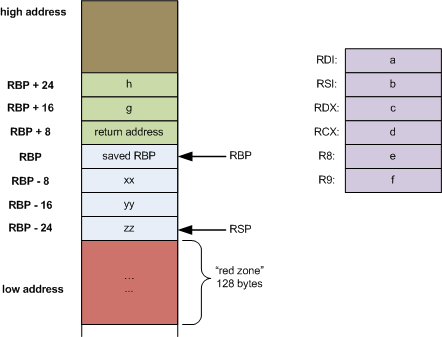
See this blog post for more information.
- 8 parameters
- 6 on registers
- 2 on stack
- caller sets up registers and stack
- caller sets return address (call)
- caller branches to the callee function
- callee saves the old base pointer
- callee allocates space for its local variables
- stack teardown happens in reverse order
Parameter example
begin main()
locals retval, x
x = 3
retval = func(x)
return retval
end
begin func(a)
return a
endAssembly
main:
  # Prologue
  pushq %rbp        # Save old base ponter
  movq %rsp, %rbp   # Set new base pointer
  push %rbx         # Save old %rbx
  sub $16, %rsp     # Allocate stack space for locals

  # Assign 3 to x
  mov $3, %rax
  mov %rax, -24(%rbp)

  # Function call
  mov -24(%rbp), %rdi
  call func
  mov %rax, -16(%rbp)

  # Set return value
  mov -16(%rbp), %rax

  # Epilogue
  add $16, %rsp     # Deallocate stack space for locals
  pop %rbx          # Restore old %rbx
  pop %rbp          # Restore %rbp
  ret               # Return

func:
  # Prologue
  pushq %rbp        # Save old base ponter
  movq %rsp, %rbp   # Set new base pointer
  push %rbx         # Save old %rbx
  sub $8, %rsp      # Allocate stack space for locals

  # Move register parameter a to local variable
  mov %rdi, -16(%rbp)

  # Set return value
  mov -16(%rbp), %rax

  # Epilogue
  add $8, %rsp      # Deallocate stack space for locals
  pop %rbx          # Restore old %rbx
  pop %rbp          # Restore %rbp
  ret               # Return