Compiler Basics
Goal: Implement a programming language
Compiling and running C code
gcc -o hello hello.c
./hello- Why do we use two separate commands?
- Does your processor run C code directly?
What does GCC do?
- Converts source code into a runnable program.
Keep in mind that gcc itself is also a program! Bash
creates a process to exec() gcc.
Two ways to implement a programming language
- Compilation: Translate to machine code to run on the CPU.
- Interpretation: Simulate the program’s instructions.
With both approaches, we have another program that takes our C code and makes it run on our machine.
These are often blended for real-world compiled or interpreted languages.
Compilation
A compiler translates your source code to machine code.
Compiler correctness
Compiled machine code should have the same outputs that the source program would.
Functional equivalence is possible when programs are deterministic. How can programs, such as random number generators, create apparent non-determinism with a deterministic program? They can by using random (or hard to guess) inputs.
Probabilistic and quantum programming languages have probability distributions as outputs.
Interpretation
An interpreter simulates the actions of source code.
Interpreter correctness
The interpreted program should have the same outputs that the source program would.
Illustrating language implementation
Getting “1+2” to run on our machine.
We assume a syntax and semantics for arithmetic operations that is similar to what C-like languages have.
Compiler approach
Translate the expression “1+2” to machine code.
// read the source code
char left = getchar();
char operator = getchar();
char right = getchar();

// generate assembly code that performs the addition
if ('+' == operator) {
  printf("  mov $%c, %%rax\n", left);
  printf("  mov $%c, %%rbx\n", right);
  // print the addition instruction
  printf("  add %%rbx, %%rax\n");
}
Interpreter approach
Interpret the result of “1+2.”
// read the source code
char left = getchar();
char operator = getchar();
char right = getchar();

// compute the result of the addition
if ('+' == operator) {
  int leftnum = left - '0';
  int rightnum = right - '0';
  int result = leftnum + rightnum; // perform addition
  printf("%d\n", result);
}
Observe that it’s pretty straightforward to interpret addition, because we have the same representation for it in C.
Key difference between compilation and interpretation
- Compiler: Prints out the machine code for addition.
- Interpreter: Performs the addition operation.
Extending the interpreter
Interpreting exponents, e.g., “2^8”?
No machine instruction or C instruction for exponentiation.
Interpreter pseudocode
read left operand
read right operand
read operator

if operator == "^":
  result = 1
  for i = 1 to right operand:
    result = result * left operand
  print result
Full example for + and ^
File: language.c
/**
  gcc -o language language.c
  echo "1+2" | ./language
  echo "2^8" | ./language
*/

#include <stdio.h>
#include <stdlib.h>

int ascii_to_int(char c) { return c - '0'; }

int main() {
  char left = getchar();
  char operator = getchar();
  char right = getchar();

  printf("input: %c%c%c\n", left, operator, right);

  printf("compiler\n");
  switch (operator) {
  case '+':
    printf("  mov $%c, %%rax\n", left);
    printf("  mov $%c, %%rbx\n", right);
    printf("  add %%rbx, %%rax\n");
    break;
  case '^':
    printf("  mov $%c, %%rbx\n", left);
    printf("  mov $%c, %%rcx\n", right);
    printf("  mov $1, %%rax\n");
    printf("loop:\n");
    printf("  cmp $0, %%rcx\n");
    printf("  jle end\n");
    printf("  imul %%rbx, %%rax\n");
    printf("  sub $1, %%rcx\n");
    printf("  jmp loop\n");
    printf("end:\n");
    break;
  }
  printf("\n");

  printf("interpreter\n");
  int leftnum = ascii_to_int(left);
  int rightnum = ascii_to_int(right);
  int result;
  switch (operator) {
  case '+':
    result = leftnum + rightnum;
    printf("%d\n", result);
    break;
  case '^':
    result = 1;
    for (; rightnum > 0; rightnum--) {
      result *= leftnum;
    }
    printf("%d\n", result);
    break;
  }
}
COP-5621 Compiler Construction
Take this course if you want to learn more about how programming languages are defined and implemented.
Compiler Internals
- Front-end: Processes input language (tokenisation, parsing, etc.).
- Back-end: Generates output language (e.g., emitting assembly code).
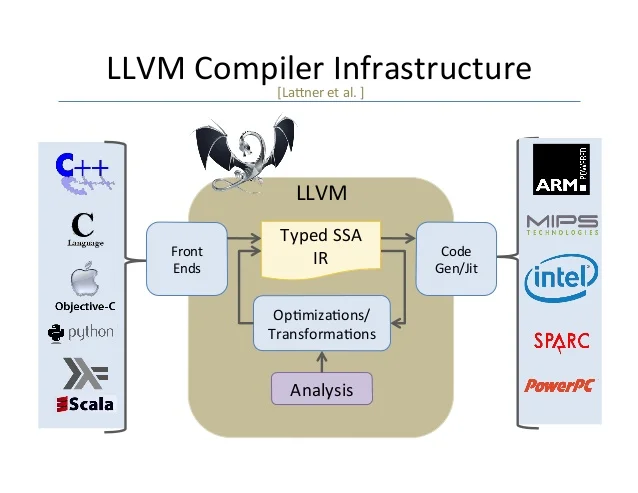
The “middle”-end
Many compilers use an intermediate language.
Why an intermediate representation?
- Easier front-end development
- Easier back-end development
- Portability
- Machine-independent optimization
- Modularization
Multiple front-ends and back-ends
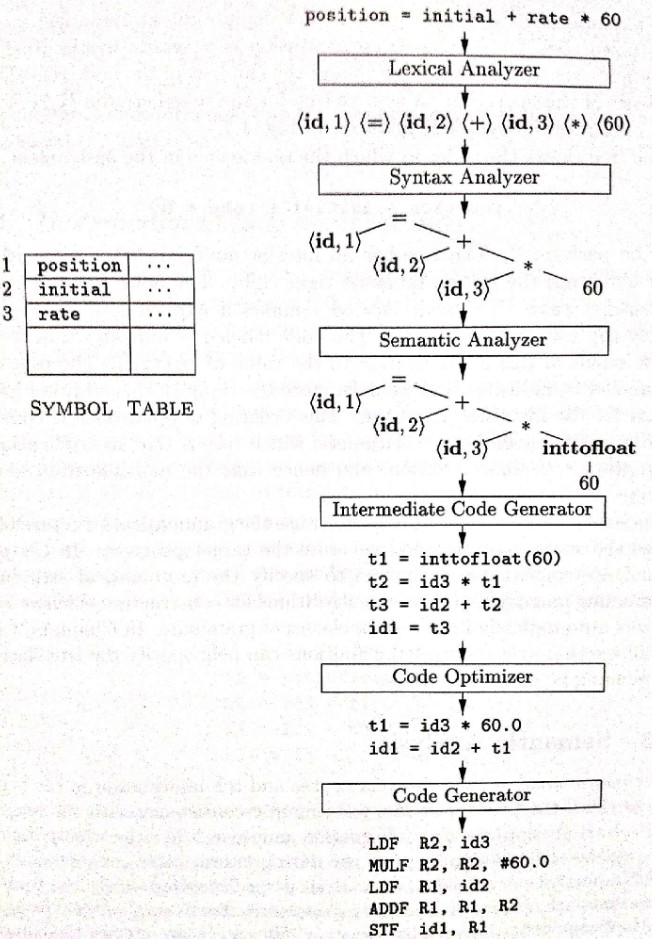
Classic phases of a compiler
Symbols versus meaning
1 + 2 3
6 / 2(1 + 2)
一加二乘三
What gives symbols meaning?
- Moon versus the finger pointing at the moon
- “The map is not the territory”
- Symbols have no intrinsic meaning.
- The interpreter/compiler/human defines their meaning.
- The compiler defines the input language in terms of the output language.
- Why does the output language have meaning?
ASCII versus machine code
odgcc -S- ASCII table
Recall interpreter last time.
- Input language numbering?
- Machine code numbering?
Syntax trees
Human language
“The boy went to the store”
Syntax: groups of words
- One sentence type:
- Subject phrase, verb phrase, object phrase
Syntactic structure captures relationships between words
“The boy leaving behind his friend went to the store.”
- Who/what went? What word goes with “went”?
- The boy “went”, because nested structures allow us to go off on another clause and return to the parent clause.
What does “store” mean?
“The store is closed.”
“Squirrels store acorns for the winter”.
The meaning of the word “store” depends on how it is used with other words: - Store as a noun: a shop that sells products. - Store as a verb: to place for later use.
Meaning also depends on structure
Arithmetic expressions
9 + 3 - 2
Compiling arithmetic expression
What is the assembly code version of “9 + 3 - 2”?
- Operations are one at a time.
- Order of operations depend on the syntax tree.
- Intuitively, you can walk the tree to compute its meaning (or generate equivalent assembly!)
Evaluating the tree
- Post order traversal.
- Leaf nodes: value of the number symbol.
- Inner nodes: value is result of operation on child values.
Ambiguity
1 + 2 * 3
- What is the meaning, i.e., the result, of this expression?
- What are the two typical ways this can be interpreted?
Parsing
- When speaking, we don’t say “noun phrase starts here”, “subject is here.”
- So how do we figure out syntactic structure?
How is source code represented?
- Just a sequence of ASCII codes.
- No intrinsic structure.
- No intrinsic meaning (ASCII numbers aren’t machine integers).
Parsing infers structure
- Parsing infers structure using word order and groupings, i.e., syntax.
Formal grammars
| Part of a grammar |
|---|
| Terminals |
| Non-terminals |
| Productions |
| Starting symbol |
Terminals
- Words or tokens.
- What you see or hear, e.g., C source code.
Non-terminals
- Names of syntactic structures, e.g., verb phrase, expression, function definition.
- Not uttered explicitly.
Productions
- Rules mapping non-terminals to their contents.
- Defines legal groupings of symbols in the language.
- Written using an arrow
nonterminal -> symbol1 symbol2 ...
Strictly speaking, context-free grammars are restricted to having a single non-terminal on the left-hand side of the arrow, but context-sensitive grammars can have more symbols on the left-hand side.
Starting symbol
- The first non-terminal in the syntax tree.
Constructs can be nested
- For example,
E -> E + num- Expressions may contains other expressions.
- For instance, 9 + 3 - 2 nests 9 + 3 inside of the subtraction operation.
Example: arithmetic expressions
E -> E + E
E -> E - E
E -> E E
=
E -> E / E
E -> N
N -> 0
N -> 1
N -> 2
N -> 3
N -> 4
N -> 5
N -> 6
N -> 7
N -> 8
N -> 9
The terminals, i.e., uttered words in the language, are the operators
(+, -, *, /) and the
digits (0, 1, 2, 3,
4, 5, 6, 7,
8, 9).
The non-terminals are the names of the grammar constructs,
specifically E for expression, num for number,
and op for operator.
The pipe symbol here means alternative, i.e.,
num -> 0 | 1 is equivalent to two rules,
num -> 0 and num -> 1.
The starting symbol, by convection, is the non-terminal on the left-hand side of the first rule.
Deriving a tree
- Find a sequence of rule applications that:
- Begins with the start symbol.
- Ends with the string.
Defining an interpreter
- Walk the tree.
- Evaluate each node of the tree.
- Define the computation for each grammar production.
Expression interpreter rules
- Assume we have implemented the following interpreter functions:
add(),sub(),mult(),div()to perform addition, subtraction, multiplication, and division computations.ascii_to_int()to convert the ASCII character value to an integer representation.
Specifying the interpreter
Define the computation for each grammar construct:
E -> E + E  { E.value = add(E1.value, E2.value) }
E -> E - E  { E.value = sub(E1.value, E2.value) }
E -> E * E  { E.value = mult(E1.value, E2.value) }
E -> E / E  { E.value = div(E1.value, E2.value) }
E -> N      { E.value = ascii_to_int(N.value) }
N -> 0      { N.value = "0" }
N -> 1      { N.value = "1" }
N -> 2      { N.value = "2" }
...
N -> 9      { N.value = "9" }
Defining a compiler
- Similar tree-walking approach.
- Generate code instead of computing the result.
Compile infix to postfix
Assume we have a function concat() for joining any
number of strings.
E -> E + E  { E.value = concat(E1.value, E2.value, "+") }
E -> E - E  { E.value = concat(E1.value, E2.value, "-") }
E -> E * E  { E.value = concat(E1.value, E2.value, "*") }
E -> E / E  { E.value = concat(E1.value, E2.value, "/") }
E -> N      { E.value = N.value }
N -> 0      { N.value = "0" }
N -> 1      { N.value = "1" }
N -> 2      { N.value = "2" }
...
N -> 9      { N.value = "9" }
Note that we no longer need to convert ASCII to a machine integer, since we can just print the output program in ASCII as well.